.png)
Buying Less, Choosing Better: The Collector’s Approach to Home Design



I see this often in the showroom.
A client walks in, usually mid-project, already overwhelmed. They’ve bought most of their furniture in a rush—sofas, beds, dining tables—everything checked off a list. But something feels off. The space looks complete, yet not settled. It lacks depth. It doesn’t feel like them.
They start slowing down at this point. They begin asking different questions—not
“What else do I need?” but “What’s worth keeping?”
That’s where the collector’s mindset begins.

The Shift from Filling Space to Building a Home
Most people approach furnishing a home as a task to complete. Rooms need to be filled, timelines need to be met, and decisions are often driven by convenience. Especially here in Dubai, where interiors move fast and new properties are constantly being handed over, there’s pressure to “finish” quickly.
But the most compelling homes I’ve seen were never rushed.
They were built gradually. Piece by piece. With intention.
A collector doesn’t buy to fill space—they buy to add meaning. That shift alone changes everything.

What I Notice About Clients Who Buy Less
The clients who end up with the most refined spaces are rarely the ones who buy the most.
They’re the ones who pause.
They walk through the showroom more than once. They sit with a piece. They imagine it in their home—not just visually, but practically. Where would it go? What would sit next to it? How would it age?
Often, they leave without buying anything the first time.
And that’s a good sign.
Because when they do come back, they’re more certain. The piece they choose isn’t just “nice”—it fits into a bigger picture.

One Piece Can Set the Direction
I always tell clients: you don’t need ten things to transform a space. You need one piece that anchors it.
It could be a hand-carved Chinese cabinet in a living room. Or a low console in an entryway. Sometimes it’s a porcelain jar that quietly draws attention without overpowering the room.
These pieces do more than fill space—they set the tone.
In many Dubai homes, layouts are open and expansive. Without a strong focal point, everything can feel disconnected. A well-chosen antique piece, especially something with history and presence, naturally brings cohesion.
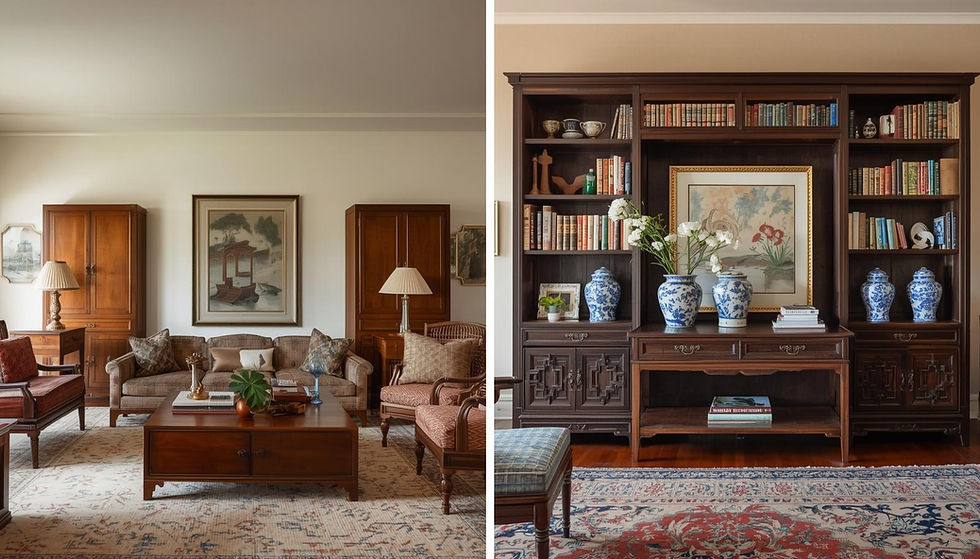
Single Chinese antique piece—carved cabinet or porcelain jar—anchoring expansive Dubai interior, showing how one refined statement piece transforms minimalist open-plan spaces.
This is where I often guide clients toward exploring our collection:
Not to browse endlessly, but to find that one piece that resonates.
The Problem with Buying Everything at Once
When everything is purchased together, everything starts to look the same.
Same finishes. Same tones. Same age.
There’s no contrast, no layering, no story.
A collector’s home, on the other hand, feels evolved. There’s a mix of old and new, refined and raw, subtle and bold. That balance doesn’t come from a single shopping trip.
It comes from time.
I’ve had clients come back months later for a second or third piece, once they’ve lived with the first. By then, their eye is sharper. They know what their space needs next—not in theory, but from experience.

Emotional Value vs. Instant Gratification
One of the most overlooked aspects of home design is emotional connection.
Not every piece needs to have a story, but the important ones should.
I’ve seen clients hesitate over a cabinet, only to return weeks later because they couldn’t stop thinking about it. That’s usually the piece they end up keeping the longest.
Compare that to impulse buys—items chosen because they “fit” or were convenient. Those are often the first to be replaced.
Buying less forces you to be more selective. And being selective naturally leads to stronger emotional value.

Practical Decisions: What Actually Matters
This philosophy isn’t just conceptual—it affects very real design decisions.
Scale:
Clients often underestimate how impactful a single, well-scaled piece can be. Instead of multiple small items, one substantial cabinet or console can ground an entire room. It simplifies the layout and makes the space feel intentional.

Placement:
When you’re not overcrowding a room, placement becomes more deliberate. A porcelain piece on a console isn’t just decoration—it becomes a focal point. Negative space around it allows it to breathe.

Colour:
Antique Chinese furniture often brings depth through muted, aged tones—deep reds, worn blacks, natural wood finishes. These colours layer well into modern Dubai interiors, which can sometimes feel too polished or uniform.

Function:
Collectors don’t ignore practicality—they just prioritise it differently. A cabinet isn’t just storage; it’s presence. A sideboard isn’t just functional; it shapes how the room is used and experienced.

Why Authenticity Becomes More Important
When you’re buying fewer pieces, each one carries more weight.
That’s where authenticity matters.
Mass-produced furniture can serve a purpose, but it rarely holds attention over time. It doesn’t age well, and it doesn’t invite curiosity.
Authentic antique furniture, on the other hand, improves with age. It has imperfections, yes—but those imperfections give it character.
Most clients who start leaning toward this approach begin to appreciate craftsmanship more. They ask where a piece comes from, how it was made, how old it is.


This is something we value deeply, and it’s part of our philosophy:
Not just selling furniture, but preserving the integrity behind it.
The Dubai Context: Why This Approach Works Here
Dubai is a city of contrasts—modern architecture, fast-paced living, constant change.
That’s exactly why a slower, more intentional approach to interiors stands out.
Homes here often benefit from grounding elements—pieces that bring a sense of permanence and calm. Antique Chinese furniture and porcelain naturally offer that.
They soften modern spaces. They introduce history into new builds. And they create a balance that feels lived-in, rather than staged.
I’ve seen minimal apartments transform with just one or two well-chosen pieces. Not cluttered—just considered.

Letting a Space Evolve
One of the hardest things for clients to accept is that a home doesn’t need to be “done.”
In fact, it shouldn’t be.
A well-designed home evolves. It reflects changes in taste, lifestyle, and experience.
When you adopt a collector’s mindset, you give yourself permission to take time. To wait for the right piece instead of settling for what’s available.
That patience shows in the final result.

A Different Kind of Satisfaction
There’s a noticeable difference in how clients feel about their spaces when they’ve taken this approach.
They’re more connected to what they own. They remember where each piece came from. There’s a sense of pride—not in how much they’ve done, but in how thoughtfully it’s been done.
It’s quieter. More refined.
And it lasts.

Where to Start
If you’re in the middle of furnishing your home, or even starting from scratch, my advice is simple:
Pause before the next purchase.
Look at your space and ask what it actually needs—not to be complete, but to feel grounded.
Start with one piece.
Not something generic. Something with presence. Something you’ll still appreciate years from now.
Build around that.


Final Thought
Buying less isn’t about restraint—it’s about clarity.
Choosing better isn’t about luxury—it’s about intention.
When you combine both, you move away from decorating and closer to collecting. And that’s where a home begins to take on real character.
If you want to explore pieces that are meant to be lived with, not just placed, visit our showroom or take your time browsing here including the client's custom pieces.
Sometimes, the right piece isn’t the one you planned for—it’s the one you recognise when you see it.
Authenticity Over Replication
At Daosden, every piece — from antique Chinese furniture to porcelain and decorative objects — is selected for its authenticity, craftsmanship, and story. We choose to present real pieces, photographed as they are, because living art should feel lived with — textured by age, shaped by hand, and unmistakably individual.
Chinese antique furniture and decorative arts endure because they were never designed to be temporary. They were built to last, to age, and to continue telling stories long after their makers were gone.
That is what makes them living art forms.

Next week, we’ll take you behind the scenes at Daos Den Furniture.
From confirming your design to the hands that craft it, through careful packaging and shipping—each step is intentional.
A quiet look at what happens after you say “yes”… and before your piece finds its place in your home.
Stay tuned!
– Jeffrey 🙂
At Daos Den, we don’t just sell furniture.
👉 Visit our Dubai showroom to discover rare finds that carry the soul of China, reimagined for homes that value heritage, artistry, and timeless beauty.
📍 Showroom viewings by appointment
📲 DM us on Instagram @daosdenfurniture


Comments